Curd thumbprint cookies

Like little jewels. Enormously satisfying to make (because they’re easy) and to offer to guests (because they are both beautiful and tasty). And they are a perfect way to use up a jar of lemon curd. Or some other curd like passionfruit or Seville orange if you’re a fancypants.

  • 170g butter, softened
  • 100g caster sugar
  • 2 egg yolks
  • 220g plain flour
  • ½ tsp baking powder
  • 1 tsp vanilla extract
  • Lemon (or other) curd
  1. Pre-heat oven to 160C fan (180C)
  2. Beat together the butter, sugar, vanilla and egg yolks until fluffy and pale
  3. Mix in the flour, baking powder and a pinch of salt until a soft dough forms
  4. Roll into balls around 3cm diameter – about the size of a 50p
  5. Place on a baking tray, evenly spaced. They won’t spread much, but you want to give them a bit of room
  6. Press your thumb gently into the middle of each one, flattening it out a bit and making a dent in the middle
  7. Fill each hole with a little bit of curd, no more than a ½ tsp. A bit goes quite a long way, so don’t overdo it or they’ll turn into sticky mini-volcanoes.
  8. Bake for 10-12 mins until the biscuit is golden brown. Cool on a rack.

Word to the wise, don’t put them anywhere near your mouth until they’ve cooled. Trying to eat one straight from the oven will most likely end with screaming and running of tongues under the tap.

If you want to make jam thumbprint cookies, I’d recommend adding the jam after they’re baked rather than before, just because it has more of a tendency to turn to liquid when it’s hot and run off to seek its fortune elsewhere. Possibly the underneath of the cookies, perhaps all over the baking tray, maybe the floor of the oven. There’s no good outcome.
Banana bread

A recipe handed down by my mum and the absolute best way to use those very brown bananas that you’ve been trying to persuade your family to eat for a week and no-one wants to touch. The addition of walnuts and cranberries adds a touch of bitterness and sourness which offsets the sweetness of the banana perfectly. I tend to buy cranberries when they’re in season and keep them in the freezer. They keep for months, and you can use them from frozen. In fact, I don’t think I ever use them for anything else. Perhaps I need to expand my cranberry repertoire.

  • 200g plain flour
  • 2 tsp baking powder
  • ¼ tsp bicarbonate of soda 
  • ½ tsp salt 
  • 75g unsalted butter at room temperature 
  • 175g caster sugar 
  • 2 eggs, beaten 
  • 450g bananas, mashed. This is quite flexible – I usually use 2-3 bananas, I’m not sure what they weigh
  • 100g walnuts, chopped roughly 
  • 100g cranberries 
  1. Preheat oven to 160C fan (180C)
  2. Grease and line a 8×4” loaf tin. I dislike this job out of all proportion to the effort it takes, so I always try to delegate it
  3. Put the flour, baking powder, bicarb and salt into a bowl 
  4. Stir in the nuts and cranberries so they’re coated with flour – this means they won’t sink to the bottom of your loaf. I don’t know why. Witchcraft? Chemistry? But it works
  5. In another bowl, beat together the butter and sugar until pale and fluffy
  6. Add egg a little at a time and beat well as you go
  7. Stir in the mashed bananas
  8. Then tip in the flour mixture and stir together (don’t beat it at this stage)
  9. Coax into the loaf tin, make sure it gets into all the corners
  10. Bake for 1 to 1½ hours. Use a clean skewer to check if its done – if you poke it into the middle of the loaf, it should come out clean

Gingerbread biscuits

Perfect for Christmas, Halloween or just a rainy Saturday afternoon when you’re being plagued with “but I’m so boooooored”. Spicy enough to please adults, sweet enough to please kids (or the adults in my life with a sweet tooth). The raw dough can be frozen if you want to split it and save some for a later weekend afternoon.

  • 350g plain flour (plus extra for rolling out)
  • 1 tsp bicarbonate of soda
  • 2 tsp ground ginger
  • 1 tsp ground cinnamon
  • ¼ tsp ground allspice
  • ⅛ tsp ground cloves
  • ⅛ tsp grated nutmeg
  • Pinch of salt
  • 125g unsalted butter, cold from the fridge
  • 90g soft light brown sugar
  • 1 egg
  • 3 tbsp golden syrup
  1. Mix together flour, bicarb, salt and spices
  2. Grate in the butter (seems like a bit of a faff but this makes combining it with the flour much easier)
  3. Mix in with your fingertips, rubbing and lifting it until the mixture is the consistency of breadcrumbs
  4. Stir in the sugar
  5. Beat the egg and golden syrup together then pour into flour/butter mixture. Stir together and mix until it starts to come together
  6. Tip out onto the work surface then press and knead briefly until it’s a smooth ball of dough
  7. Wrap in clingfilm and leave to rest for 15 mins
  8. Pre-heat the oven to 160C fan (180C) and line 2 baking trays with greaseproof paper
  9. Roll out the dough on a lightly floured surface to around ½ cm
  10. Cut out shapes and place on baking tray
  11. Bake for 12-15 mins until lightly golden brown
  12. Leave on the tray for 5 mins to firm up and then transfer to a wire rack to finish cooling
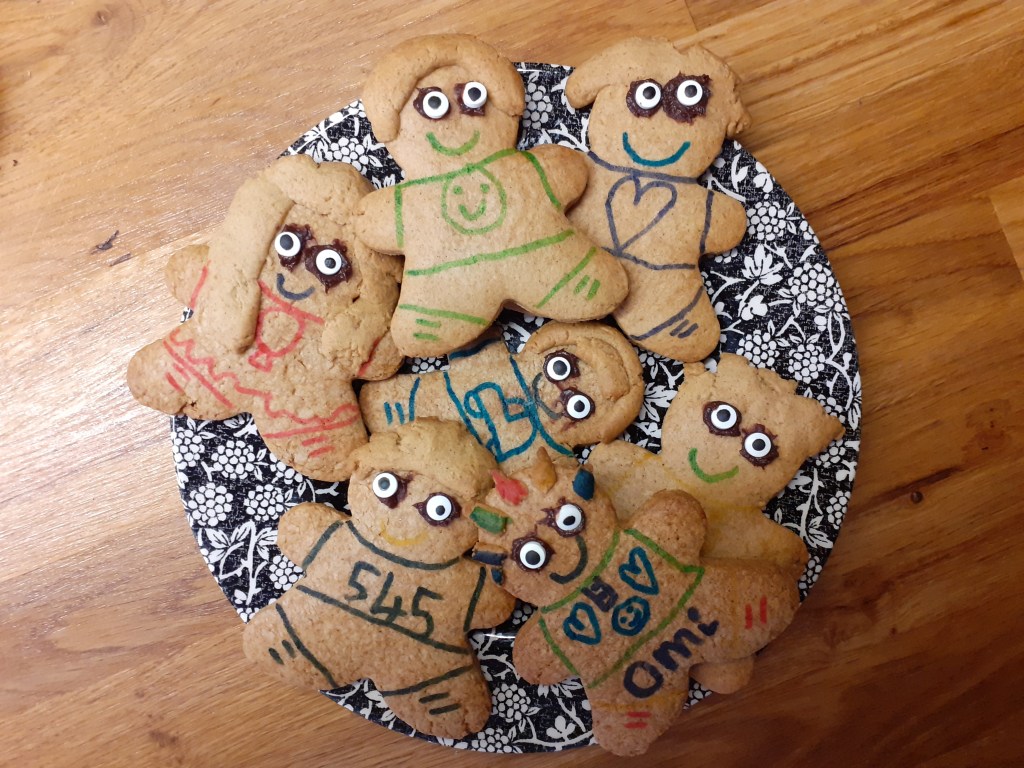
  13. When cool, decorate with icing sugar paste and ALL THE SPRINKLES

Flapjacks

Our family’s recipe for nubbly, chewy, crunchy flapjacks. Endlessly adaptable, brilliant to make with children.

  • 115g butter
  • 1 tbsp golden syrup
  • 1 level tsp bicarbonate of soda
  • 90g porridge oats
  • 60g plain flour
  • 80g soft brown sugar
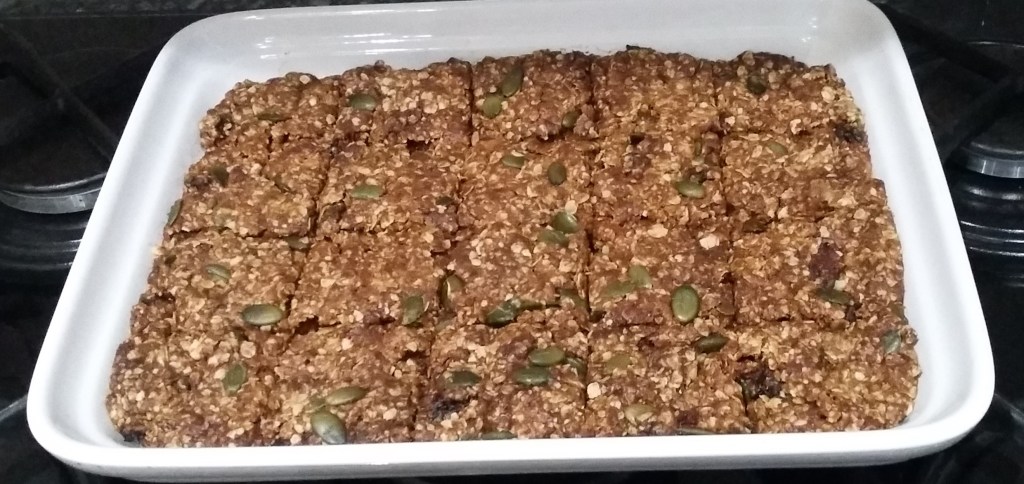
  • A couple of handfuls of chopped dried fruit, seeds, nuts, desiccated coconut. (You can use anything dried. Our family faves are raisins with pumpkin seeds and sunflower seeds; dried cherries with flaked almonds; and dried pineapple with flax seeds and desiccated coconut. You could even add chocolate chips and banana chips, which is how my dad likes them, but I feel as though they suddenly become not breakfast-appropriate if you do that!)
  1. Preheat oven to 140C fan (160C)
  2. In a big bowl, mix together oats, flour, sugar and your choice of fruit/seeds
  3. Melt the butter in a small pan on the hob, then add the syrup and stir together
  4. When combined, take off the stove and add the bicarb. Stir until frothy and then pour over the dry ingredients
  5. Mix well until everything turns flapjack-coloured
  6. Tip into a baking tin or dish – I usually use a rectangular ceramic dish so I don’t have to line it. Press down with your fingers into all the corners
  7. Cook for 30 mins until golden brown
  8. Remove from oven, cut into squares with a sharp knife but leave in the tin until completely cooled
  9. Store in an airtight container

Milena’s vanilla kipfel

My Czech granny’s recipe for vanilkove rohlicky. Melt-in-the-mouth, crumbly vanilla-scented crescents, traditionally made for Christmas. Our family celebration isn’t complete without a selection of little biscuits or pecivo.

The recipe is so simple, it’s a bit intimidating – the original directions simply said to “mix ingredients” and then to “bake”. That was it. I’ve included a bit more detail

  • 200g plain flour
  • 150g unsalted butter
  • 100g ground unblanched almonds (suggest grinding them yourself if you can. You could also use hazelnuts or walnuts)
  • 50g caster sugar
  • Vanilla icing sugar for finishing
  1. Pre-heat oven to 150C fan and grease or line baking tray
  2. Mix ingredients. It will feel as though the mixure is too dry and it won’t come together. Don’t be tempted to add liquid, it will happen!
  3. Make into crescents. Traditionally approx 5cm long. Don’t use too much dough, these are quite small. Roll between your fingers to made a slightly tapered sausage, and then curve round into a crescent shape
  4. Place on baking tray and bake for around 20 mins until slightly golden. Don’t over-cook
  5. Shake in vanilla icing sugar (or sift over) whilst still warm and then leave on a rack to cool
  6. Store in an airtight tin with any leftover icing sugar

If you don’t have vanilla icing sugar, you can make some in advance by putting used vanilla pods into icing sugar and leaving for 2 weeks, shaking periodically. Or if you’re not organised enough (I’m not), you can just add 1 tsp of vanilla extract to the dough mixture.

You can also make vanilla extract by sinking used vanilla pods into a bottle of vodka (around 4 pods to 200ml alcohol), and I always add a couple of tbsp sugar too. It should be ready to use in a few weeks, but will get stronger the longer you leave it. A higher proportion of vodka will result in some absolutely delicious vanilla vodka, rather than vanilla extract.

Quick chocolate cake

Our family’s birthday cake recipe. It’s quick, incredibly easy and makes a cake that is moist, chocolatey and satisfying without being heavy or overly rich. It also doesn’t involve creaming butter and sugar which is a huge point in its favour for me! I’ve given this recipe out probably more than any other.

  • 60g dark chocolate
  • 110g unsalted butter
  • 200g caster sugar
  • 125ml milk
  • 120g plain flour
  • 2 tsp baking powder
  • 2 eggs
  • 1 tsp vanilla essence
  1. Pre-heat oven to 170C fan (190C)
  2. Grease and line 2 identical baking tins (or 1 big one if you don’t want to make a sandwich cake)
  3. Melt together the chocolate and butter. I used to use a bain marie, now I just melt in the microwave – 40 seconds at a time, stir and check
  4. Pour the melted chocolate and butter into a mixing bowl
  5. Beat in the sugar, milk, eggs and vanilla
  6. Tip in the flour and baking powder, and a pinch of salt
  7. Mix until just combined – don’t over-beat it
  8. Pour (yes, it’s that liquid, don’t worry) into the lined tins and bake for 25-30 mins until well risen and cooked through. If cooking in 1 tin, bake for about 10 mins longer)

You can also use the same recipe to fill cupcake cases and cook for just 15 mins. Or 4 times the recipes fills a deep roasting tin, which will need about 40 mins but makes an excellent option for large numbers.

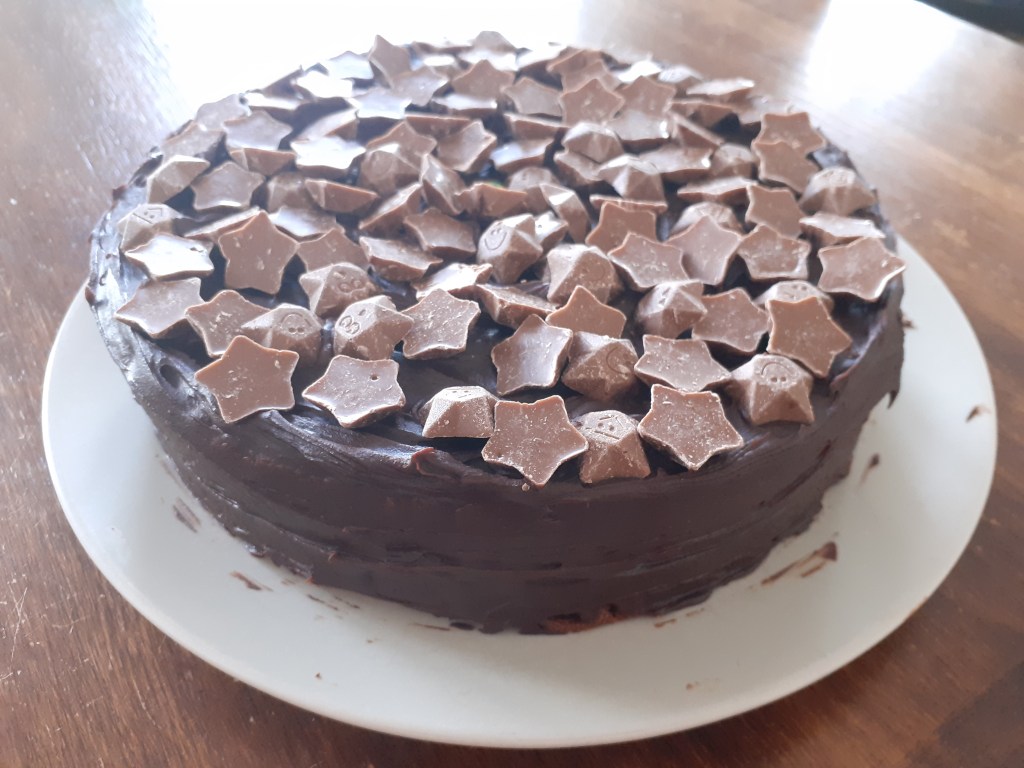
Ice once cool with the chocolate glaze below. It’s the best chocolate icing ever. And no clouds of icing sugar to contend with. This quantity will ice the cake above, with enough to sandwich between the 2 cakes as well as coating the top and sides.

  • 3 tbsp milk
  • 3 tbsp caster sugar
  • 30g unsalted butter
  • 85g dark chocolate
  • A drop of veg oil
  1. Break the chocolate into a bowl and add the other ingredients. You won’t believe it will turn into a beautiful, glossy, smooth icing, but trust me, it will.
  2. Melt together in a bowl over some hot water or in short bursts in the microwave. It will look terrible until it suddenly doesn’t
  3. Once the icing has cooled slightly, use a spoon to spread over the top and sides of the cake. Top with chocolate sprinkles/maltesers/candles. The cooled icing will set so it’s not crunchy but will hold its shape.